
1. Purpose
Our Volunteer Strategy is one of six underpinning strategies which support and enable the delivery of LHCRT’s overall Strategy and Operational Plan.
This strategy describes how the Trust will recruit, and retain sufficient volunteers to:
- understand and meet the volunteer/skills requirements inherent in developing future Operational Plans.
- meet the objectives of the Trust’s overall strategy and the current Operational Plan (OP).
Volunteers are our lifeblood. Without them we would not have been able to achieve all we have since the Trust formed in 1988 nor will we be able to deliver our Operational Plans to achieve our aim to restore the canals.
2. Strategic Objectives
There are four volunteering objectives:
- Attracting the right volunteers at minimal cost.
- Providing a positive volunteer experience – making people feel welcome and valued, providing good induction, training and development to help them optimise their contribution and a sense of achievement.
- Optimising retention – volunteers having a positive experience. Happy volunteers stay with us, are more productive, spread positive messages to others and recommend us as an organisation. Unhappy volunteers who’ve had a poor experience will do the opposite.
- Future fit – ensuring the Trust has the volunteer capacity, skills and leadership pipeline needed for current and future operational plans.
The strategy looks first at the current situation, then defines volunteer requirements before setting out actions to achieve the above objectives, thus bridging the gap between the two.
3. Current situation
Current volunteers
We have many regular volunteers who make an enormous contribution, applying their skills with huge enthusiasm to achieve remarkable results. There is a wide range of individual contributions, from an occasional few hours, to others working the equivalent of a full-time job, sometimes alongside paid employment, caring responsibilities, family commitments, and other interests. None are remunerated. Throughout 2025 we had 126 volunteers, some working in more than one role.
Volunteer structure
Our volunteers broadly fall into two groups, front line, and support roles behind the scenes.
- Front line comprises three categories – two construction, a green and grounds, and events teams.
- Support has four categories – vehicle and plant maintenance, communication and marketing, planning and technical (eg: planning, drainage, land, and property etc.), professional support (eg: finance, health and safety, procurement, risk, governance etc.)
Front-line and support volunteers work closely together with several having roles that cross over, for example professional support Trustees who also volunteer with the construction and green teams and work party regulars who get involved in various events.
Volunteer types and demographic
The top three types of volunteers in terms of numbers are:
- older people near, at or post-retirement with more time available than those still in work.
- young people with us for a few months who are undertaking their Duke of Edinburgh Award.
- corporate volunteers typically joining us for a one-off project for one or a few days.
Volunteer hours
Total volunteer hours in 2025 were 24,227 (equivalent to 3,274 days and a notional monetary value of £1,001,370), with timesheet completion mandatory and now largely universal. Diagram 2 provides analysis.
Volunteer hours by type of work
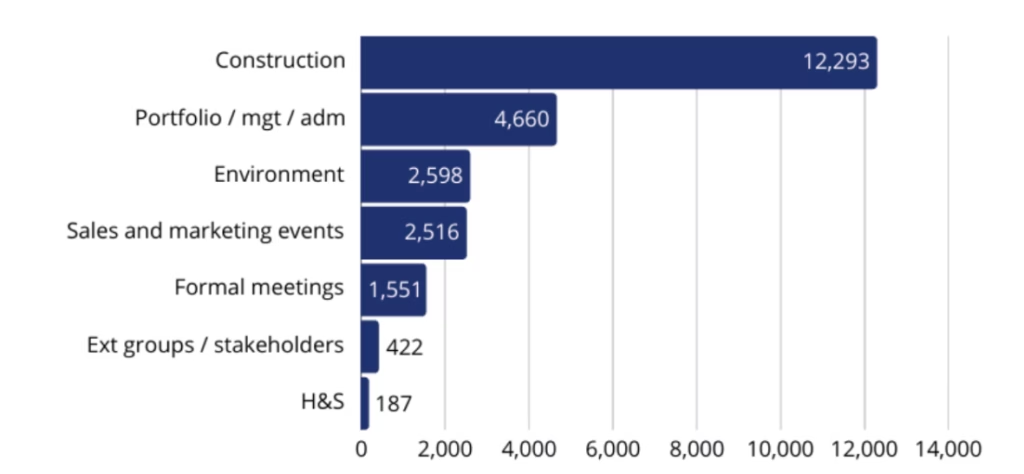
A summary of hours donated by Trustees is set out in the table below. Some trustees have significant workloads and others less so, dependent on the role, availability, and motivation of the individuals.
| Year | Total hours | Range | Average |
|---|---|---|---|
| 2024 | 5,621 | 42.5 – 1,735 | 803 |
| 2025 | 6,869 | 22.0 – 2,198 | 981 |
| 2026 to June | 43.0 – 858 |
Volunteer groups
- Trustees – Board members, each with a specific portfolio., Many some of whom also have other roles such as assisting with events, the green team, ad hoc activities or covering vacancies.
- Managers – regular volunteers who are not Trustees but have a specific role, some of whom attend Board and contribute to discussions and decision making. Examples include officers dealing with our fleet of plant, vehicles and equipment, corporate volunteers, health and safety, volunteer liaison etc. (this list is not exhaustive).
- Regular team members – typically with the marketing, green and grounds or construction and operations teams, all making things happen both on the front line and behind the scenes.
- Occasional and one-off volunteers – join us intermittently when their commitments allow and/or for a particular activity that interests them. Some go on to be more regular team members whilst others may never return.
- Corporates – people from local organisations, often on corporate social responsibility days, deployed at a particular location or task. Dependent on their skills, they may tackle green and grounds work or towpath construction. Occasionally we have offers from firms in relevant industries whose qualified employees can also advise on technical matters on a pro bono basis.
- WRGIES – groups of volunteers operating under the banner of the Waterways Recovery Group, tending to visit for a week or two and deployed on more substantial projects. Some have enhanced skills and having experience elsewhere on the national canal network. We cover accommodation costs and provide equipment and materials.
- Schools and colleges – typically young people seeking productive work experience to support their vocational studies including bricklaying, construction, vehicle maintenance, ecological activities and green and grounds.
- Scouts and voluntary groups – eg: Explorer Scouts doing more complex green and grounds work, younger Scouts collecting bricks and testing the quiz, the Lichfield Ladies Circle and so on. They tend to be occasional visitors.
- Duke of Edinburgh Award – school age young people, mostly local, who join work parties (eg: the regular Saturday morning group and some run in the evenings) and are deployed in a variety of green and grounds activities and occasionally some reclaiming of bricks etc. They are our largest group of volunteers and each young person spends three months with us, although some continue beyond that. Two of our plant team are former DofE students. We’ve had Bronze, Silver and Gold award participants.
Equality, diversity and inclusion (EDI)
We started collecting some personal data in 2022 to fulfil the requirements of our EDI Policy. When compared with the published 2021 census data for Lichfield we can see that our volunteer group is not fully representative of the local population. This is partly due to having an older age demographic.
Retention
We have a good-sized group of motivated volunteers, working together to make tangible progress in constructing the Lichfield Canal. Individuals give variable time according to their other commitments. Recruitment sources vary from word of mouth, website, and volunteer fair enquiries to responses to
targeted advertising. There’s a broad skill mix, although some do not wish to use skills gained in former professional careers, nor do we have comprehensive skills analysis.
Some are longstanding volunteers, having served for 10, 15, 20 years or more. Most volunteer at least once a week, with 50% either a few times a week or most days. Several carry significant workloads, have a lot of experience and possess important corporate memory which demonstrates a reliance on a
small number of people whose collective departure could have a disproportionally negative impact. However, recent turnover has enabled skill transfer, and new structures a sharing of responsibility. Others stay only for a brief time for several reasons from personal to Trust specific. Front-line teams welcome a steady average of two to four new volunteers per month, sufficient to sustain the existing teams.
Changes to the onboarding process in 2025 have improved volunteer retention however, at certain times and, primarily due to changes in work scope, there has been an excess of volunteers or a short-term skillset shortages, with the following disbenefits:
- Loss of volunteers as no work, or work which does not match their skillset, is not available.
- Inefficient working due to short-term skillset shortages, e.g., bricklaying, grant/planning application experience, and deputy team leadership.
- Pressure on team leaders to keep volunteers occupied.
This can be eased by greater clarity, and effective management of short- and medium-term programme of work and supporting volunteer resource requirements. A project manager is now in place to provide these mitigations.
Team leaders have a critical role, and there’s been some success in facilitating existing team members to take on the additional responsibilities of a deputy or team leader role. However, there’s more to do to avoid loss of work or use of inefficient short-term expedients when a team leader is not available.
Support teams
There’s a broadly solid history of filling support vacancies via focused recruitment, but there will always be periodic vacancies needing to be filled.
Management
Retention of Trustees is generally good, with some exceptionally long serving and hardworking Board members. Succession planning was used effectively for the Finance & Funding post and targeted recruitment has seen skilled individuals taking on key portfolios. Improving the current onboarding process for some managers and Trustees would bring benefits but other factors, such as misapprehensions, changes in circumstances, unrealistic expectations, workload, ineffective communication, or lack of familiarisation are also relevant.
Some Trustees and managers carry an extremely high workload and demonstrate elevated levels of commitment and contribution. Whilst for some, this aligns with their personality and default workstyle, there is an inherent risk of lack of sustainability and single points of failure.
Training and development
Longstanding volunteers, particularly team leaders, acquire unique skillsets and experience which a new volunteer is unlikely to have, and cannot be sourced via focused recruitment. Whilst recognising the value of providing training and development for volunteers there is no formalised process to ensure that the essential skills and experience of our existing volunteers are captured and passed on to potential future managers or Trustees.
The development of a process which provides recognition of a volunteer gaining increasing level of expertise, culminating in a skillset which will enable them to undertake the role of deputy manager or Trustee and succeeding them, is a key objective.
4. Volunteer Requirements
This section sets out what the Trust needs from volunteers. This has been established through surveys, discussions with Trustees, managers, front line and support volunteers, observation and research. The assessment also takes into consideration why people volunteer with Appendix 1 providing useful
context. It’s also been informed by research into why people stay, with Appendix 2 summarising the issues regarding retention. A summary of the 2025 volunteer survey outcomes appear at Appendix 3.
What we need from all our volunteers
To be successful, we need a wide range and substantial number of volunteers with the skills, experience, and motivation to put our plans into action. The areas with greatest need are in construction, green and grounds and events. Whilst we have role profiles, they can only ever be an indication, and we have the flexibility to match the skills, experience and wishes of individuals to what needs to be done.
Inevitably the flux of work and availability of volunteers don’t always align, impacting ability to progress, sufficient work to be done and the choice of activities available. The key attributes of all volunteers are:
- Skills (of diverse types) to share and deploy.
- Availability to be involved when needed.
- Personable and able to get on with others.
- Willing to work within our values and health and safety guidelines.
- Motivated to get things done.
- Flexible to work on the things that need to be done (within reason).
And from those in a team or site leader capacity:
- People skills
- Leadership skills
- Communication skills
What we need from managers
We need managers with practical skills and experience in a wide range of disciplines. These individuals are in key roles and translate LHCRT’s strategy and plans into practical action on the ground. They typically spend considerable time on Trust activities and collaborate closely with Trustees (some
attending Board meetings) and provide valuable advice, an important interface between the Board and volunteers in other roles.
Managers attending Board:
- Construction – coordination of construction, operations and liaison on planning and design
- Corporate/green & grounds – environmental issues, coordinating local organisations, planning work, liaising with team leaders, inducting and supervising on volunteer days.
- Health and safety – overseeing and advising on health and safety issues.
- Volunteer liaison – interface with volunteers working on the front line.
Other managers
- Events – various roles at events, shows, and other activities.
- Technical facilitation – provide effective communication between the Planning & Technical (P&T), Construction & Operations (C&O) Trustees and front-line C&O volunteers
- Procurement – Ensure cost-effective and transparent expenditure of LHCRT funds
- Finance – manages the day-to-day accounts, keeps accurate financial records, processes payments, and ensures bills are paid on time.
Some managers may wish to progress to a Trustee position, whilst others are content in their current roles. Their experience and skills have some alignment with what is required of Board members.
What we require from Trustees
Skills and experience in a wide variety of disciplines, including:
- Comms and marketing – to manage social media channels, website, produce and edit our publications (Towpath Times, CBW and Annual Report etc.), undertake advertising, promotion and reputation management.
- Construction and operations – construction of the canal, planning and executing the necessary building work, ensuring on site deployment and health and safety of volunteers.
- Environment and ecology – advise on all environmental matters, develop and implement plans, policies and practices, oversee the grounds and green teams and promote creation and maintenance of diverse habitats.
- Finance and funding – budgeting, financial administration, VAT returns, banking and management accounting and identification, application for and administration of grants.
- Governance – risk management, health and safety and legal and administrative activities.
- Volunteers – coordination of our approach to volunteering, including recruitment, induction, onboarding, training and undertaking ongoing volunteer liaison.
- Planning, technical, land, drainage etc. – to draw up and achieve planning permissions, design and construction of the canal, advise on land, property and drainage issues etc.
- Strategy – able to look ahead, see the bigger picture, identify overall direction and the resources to enable that, strategic and operational planning and delivery, stakeholder engagement and management.
- Leadership – a blend of character, emotional intelligence and strategic skills including vision and strategy, integrity and character, self-awareness, communication, emotional intelligence, resilience, and problem solving.
These activities are currently spread amongst ten Trustee roles. Specific role profiles have been
developed for Trustees and managers which set out both an outline of what each role encompasses
(although these are, to various extents, flexible according to what the volunteer has capacity for) and a
brief standard person specification covering skills, experience and attitudes, as follows:
Skills:
- Understands the issuesfacing the Trust.
- Operates effectively at high levels and successfully guides and advises Board members.
- Good verbal, written and presentational communication skills.
- Good interpersonal skills and able to work well with a range of people.
- ICT skills.
Competencies and knowledge:
- Understands their specific role.
- Able to prioritise work and work well under pressure.
- Attention to detail.
- Experience in their portfolio is advantageous but not always essential.
- Awareness of equality and diversity issues and the need for all Board members, volunteers, members, and other stakeholders to be treated fairly and equally.
Attributes:
- Works in accordance with and demonstrates the Trust’s values.
- High standards of probity and integrity.
- Self-motivated,showing energy and enthusiasm.
- Demonstrate a flexible approach.
- Team player; diplomatic and measured.
- Organised and effective with a strong work ethic.
- Authentic personal and professional credibility that commands confidence at all levels.
The Trustee Code of Conduct sets out more details of the role and expectations of Trustees, and every post holder is required to sign to demonstrate their intended adherence to it. Examples include timely and reliable responses to communications to enable effective decision making and governance.
External support:
When we don’t have the necessary skills, experience, or capacity within our existing volunteer group, we are prepared to pay market rates for specific professional or technical advice and/or to engage contractors to do the work. Sometimes, grant funders require a particular project to be done by contractors. Given our limited funding and our commitment to financial prudence, we will always seek to achieve value for money and try to negotiate rates to optimise our available funding.5.
5. Gap analysis
Based on an assessment of what the Trust requires against what we currently have, the following requirements have been identified, which form the basis of the longer-term strategy and inform the action plan to be captured within the 2027/28 Operational Plan:
- Provision of effective support to Team Leaders and Trustees via focused volunteer recruitment, succession planning and volunteer training.
- Formalising the recruitment and onboarding of new managers and Trustees to ensure effective selection and their rapid familiarization of key Trust activities and processes.
- Utilisation of increased clarity and detail of the future development/construction programme to provide a better ‘fit’ between volunteer expectation/capabilities and the programme volunteer resource/skillset requirements,
- Development of a training scheme which provides recognition to a volunteer gaining increasing level of expertise, culminating in a skillset which will enable them to undertake the role of a deputy manager or Trustee and potentially succeeding them.
- Development of more flexible volunteering opportunities and recruitment, across all Trust activities, to both attract volunteers from individuals in full employment, age ranges not currently well represented, young unemployed, etc. and support the objectives of the Trust EDI Policy.
6. Volunteer action plan
An Action Plan has been developed flowing from the above gap analysis. It focuses on a twelve month period, with the objectives of:
- Sustaining the existing organisation, teams, and individual volunteers, to enable them to complete the current Operational Plan (OP) objectives.
- Understanding the volunteer/skills requirements inherent in the developing OP.
- Identifying and completing actions which will enable future volunteer requirements to be met; thus, contributing to the successful implementation of the OP activities.
Each action addresses issues in one or more of the above three categories. The Action Plan is to be reviewed and updated in a minimum of 12 months to ensure it aligns with the Operational Plan.
Connections
The Volunteer Strategy both draws from, and supports, other key LHCRT documents; in particular those listed below:
- Communications and Marketing Annual Plan
- Education Policy
- Equality, Diversity, and Inclusion Policy
- Governance Structure
- Health & Safety Policy, Statement of Intent and allied documents
- Trust structure, role profiles and workplans.
- Trustee Code of Conduct
- Volunteer Hub
Appendix 1: Volunteer recruitment
Why do people volunteer?
We first need to understand both why people volunteer and why they don’t. Each individual has a different combination of reasons. Understanding this can inform how we recruit, retain and nurture volunteers, deploy them to optimise their contribution and thereby deliver our plans.
Ideally what we need from volunteers should align as closely as possible with what they want from us. To achieve this, it’s important to understand what motivates people to join and stay with us.
The barriers to volunteering
There are several barriers to successful recruitment and retention of volunteers. This ranges from never having thought about it, not having been asked or lack of self-confidence to not wanting to make an ongoing commitment, having a lot of other things in their lives or worries about not fitting in. As with the many and varied reasons for volunteering, there are as many reasons for not doing so. We need to ensure we remove or minimise any barriers so that volunteers feel they can do as much or as little as they want to.
What encourages people to volunteer?
Research on what encourages people to volunteer consistently shows that flexibility is key, as is knowing what opportunities are available, feeling welcome and supported, finding it easy to get involved, doing activities that are enjoyable, provide personal growth and being part of an organisation that has a good reputation.
External influences
The Trust needs enough volunteers with the right skills, experience, availability, and motivation to enable us to restore and maintain the canals. Times are changing and so is what we need. Construction is now more regulated than it was when we first formed with stringent health and safety, CDM, planning
and risk management requirements. Ecological and climate change issues are increasingly front and centre.
Fundraising is more complex with significant effort and skill required to apply for and administer grants, with awarding bodies wanting evidence of our good governance and up to date policies (eg: EDI, health, and safety, safeguarding etc.).
Recruitment publicity
Current volunteers joined us via numerous routes from word of mouth, canalside information boards and volunteer fairs to responding to an advert or on-line article. All remain important.
Barriers to recruitment
We must understand and address barriers to recruitment and ensure we have an attractive offer that stands out from other volunteering opportunities. This SWOT analysis summarises the key issues.
Strengths
- Long established organisation with a good reputation
- Clear vision and reason for being
- Track record of attracting volunteers
- Hardworking and motivated volunteers
- Wide range of skills amongst current group
- Corporate standard comms and marketing
- Sound financial management and control
- Up to date EDI, safeguarding, H&S etc policies
- Active on social media channels/website
- High profile supportive Vice President/patrons
Weaknesses
- Some missing skills/experience
- Some high workloads
- Some lack of consistency (induction, H&S)
- Some untidy sites
- Seen by some to be ‘niche’
- Perceived slow progress/stop and start/long lead time to completion
- Some aspects of the volunteer demographic
- Aging kit
Opportunities
- Tangible project successes (Darnford Moors, Borrowcop Canal Park)
- Successful succession planning examples
- Clear strategy and operational plans
- Track record of securing substantial grants
- Local population demographic is a good volunteer pool
- Broadening our appeal to new people
- Modernised look and feel across all activities
- Flexible approach to fitting people to roles
- New patron
- Increasing focus on ecology and climate
Threats
- Competition from other charitable and voluntary organisations.
- Economic conditions potentially impacting on funding/costs/contributions
- Aging demographic in some teams
- More stringent regulatory framework
- Resistance by landowners
- Not progressing sufficiently quickly due to limiting factors such as funding, planning consents or land access.
- Busy modern lives
The key actions that will help us to deliver these outcomes are:
- Reputation – we need to present a consistently good external image, with broad appeal to new people, look and feel modern, up to date and effective. This is important as we are in competition with other voluntary organisations and we need to ensure our USP is attractive and welcoming.
- Advertising – realistic, attractive, and engaging adverts, ensuring they look and sound interesting, realistic (we are not employers) and emphasising that flexibility is the norm. Using existing channels (website, social media, Reach Volunteering, CBW etc.), and extending this to include asking our patrons, friends, and local printed media to include call outs for people to join us.
- Broad based – ensuring we place articles or adverts in both specialist and mainstream media, making the most of social media channels, whilst still recognising the value of more traditional approaches including word of mouth and information boards on the canal.
- Advocates – current volunteers can be our biggest advocates if they have a wonderful experience with us and speak highly of us to others and encourage people to join. Our Vice President and Patrons can share messages with a broader base of contacts than we can ourselves. We are
working on a stakeholder management plan to support us further in our endeavours. - Presentation – our event stands must be attractive to a broad base of people with uncluttered displays, printed signage, and be clean, tidy, and well presented. Any presentations to external audiences need to have excellent quality slides and engaging and responsive speakers.
- Publications – need to be attractive, modern, accessible, and relevant to a wide range of potential volunteers. Photographs and films need to appeal to a wide audience, feature our diverse volunteers in terms of age, gender, ethnicity, and other protected characteristics to demonstrate we are open and welcoming. Social media needs to be short, snappy, and fun to appeal to the TikTok generation whilst continuing to cater for the enthusiasts with longer and more detailed films providing more information.
- Flexibility – aligning roles to the volunteers who come forward. As in all recruitment, securing people who are an exact or perfect fit for a particular role is a rare thing, more so in the world of unpaid volunteering. We need to be always prepared to carve out useful roles, splitting and recasting role profiles, thereby making the most of the skills and experience of individuals to do what needs to be done.
Appendix 2: Volunteer retention
The retention of volunteers is highly dependent on the quality of their experience with us, from first contact, through onboarding, training, development, enjoyment of the activities they do, their sense of achievement, their Trust work/life balance Trust and how they feel about LHCRT, their team leader and
workmates. The key issues that help us to deliver these outcomes are:
Pipeline and onboarding
- Reputation – we need to present a good external image, with broad appeal to new people, look and feel relevant, up to date and effective.
- First contact – good quality email response within a few days, with a follow up phone call within one week. Everyone is responsible for good first contact, prompt contact following application, interview asap (especially for Trustee roles) and timely and effective follow up. It must be a
professional and positive experience. - Induction process – done ahead of or on day of first shift, straightforward, excellent quality, professional, consistent, in line with our values and covering all it needs to (ie: not just health and safety).
Active experience
- Training – ensure volunteers are trained to do the task in hand, the right equipment and tools are available and people can develop and progress their skills if they want to. Skills audits are a useful tool to inform in-house training. First aid is provided externally, and some plant training is provided
by WRG. Other external training provided must have a clear need identified as, being a voluntary organisation, we need to optimally target our scarce resources. - Workload – ensure that workload is planned and explained how it fits into the wider vision and that it is shared out appropriately to avoid overloading some individuals.
- Health and safety practice – consistent across all sites.
- Volunteer information – sharing information via Forum, WhatsApp groups, social media channels, team briefings, and the Volunteer Hub as the primary route for finding out about what the Trust is doing.
- Leadership – good quality day to day leadership from team and site leaders plus strategic thinking and clear direction from Trustees and managers. Volunteers must feel valued, that their ideas and suggestions are welcome and that they can regularly provide open and honest constructivef eedback.
- Appreciation – those in leadership positions always thanking volunteers for what they do for the Trust.
- Achievement – being a part of delivering our plans, tangible outcomes and moving the project forward.
Forward thinking
- Strategy – clarity about what we are trying to achieve and realism about timescales and planning.
- Succession – encouraging and supporting a pipeline of new volunteers to take over to ensure continuity and delivery of our aim. We need to encourage young people to become and remain involved.
- Modernisation – an organisation that is continuously evolving, current and up to date in its approach.
- Trustees – visible, appreciative, and ensuring clearer understanding of what they do.
Appendix 3: 2025 volunteer survey
Survey respondents told us that their top five reasonsfor volunteering were: putting something back into the community, gaining a sense of achievement, passion for the project, heritage preservation and social contact/ making new friends. However, most had a variety of reasons for working with LHCRT and there were eighteen more motives, ranging from using existing skills and learning new ones to improving mental and physical health and doing something different. This demonstrates that motivation is very personal.
Satisfaction
97% said they were satisfied or very satisfied with their experience and all were likely or very likely to recommend us to others. 91% said they felt valued or very valued as a volunteer, with three people feeling neutral about that. On a scale of 1 – 10 where 10 is very positive and 1 very negative, the average
score was 8.7 within a range of five (two people) to ten (eight people). All said they were likely or very likely to continue to volunteer with us, but we don’t know what non-respondents think.
Leadership
Feedback on team leaders, site leaders and supervisors was mixed. There were positive observations on those leaders who hold team meetings/briefings and prioritise health and safety. The majority were described as ‘always or often’ supportive, appreciative, easy to get on with and contact and speaking
well of LHCRT and others. Other respondents stressed the need for better work coordination, communications (briefings – at the start of each shift from their team leaders, regular team meetings, exchange of technical information, etc.) and training.
Views about the Board of Trustees were generally positive from those who have contact with them. About half, on average, did not know all Trustees or what they do. The strongest scores in terms of ‘all or most Trustees’ were; easy to get on with, effective and speak well of LHCRT and other volunteers.
Areas that were highlighted as requiring more work are; visibility, prioritising health and safety, and demonstrating appreciation.
Overall, volunteers want to enjoy their experience with us, feel they are doing something worthwhile for which they are appreciated, receive support and good leadership and kept well informed.
June 2026